Jun 15, 2026
When the password is a conversation: voice-verified unlocks in toys and gifts
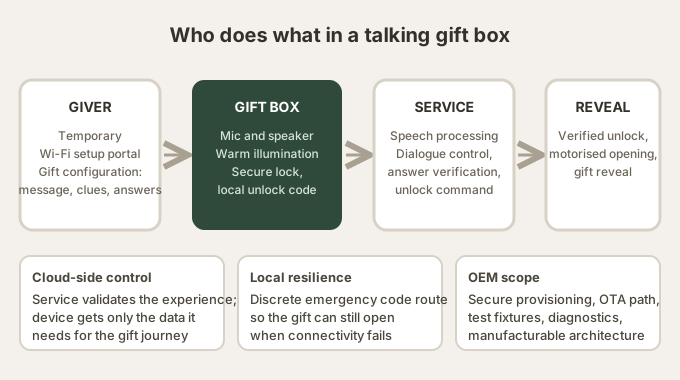
A lock usually wants a key, a code or a fingerprint. A growing category of gifts and toys replaces all three with a conversation: the product asks, the recipient answers out loud, the system verifies, and something physical happens — a lid opens, a compartment unlocks, a prize is released. Designed well, verification feels like magic; designed badly, it feels like voice recognition failing in front of an audience.
The verification has to be forgiving
People do not answer in canonical strings. They paraphrase, they answer in the wrong language, a sibling shouts a hint from across the room. The verification layer needs fuzzy matching with a wide acceptance band, plus explicit designer control: which answers are exact, which accept synonyms, which triggers a hint instead of a failure. The worst possible design treats a near-miss as a hard failure.
Failure is content, not an error state
Every failed answer is another beat of the interaction. The product should respond with character — a tease, an extra clue, a light animation — and never with a bare error. Teams that script failure responses with the same care as success responses ship products that children replay deliberately to hear the box be cheeky.
The audio chain is the real product
A conversation-verified lock lives or dies on the audio chain: far-field microphone pickup in a noisy birthday room, echo cancellation so the box does not hear itself, speaker loudness that survives a party. This is the part of the bill of materials worth spending on; the unlock mechanism itself is commodity engineering.
Where the decision happens
Keeping speech processing in a connected service gives you flexible dialogue and verification logic; keeping a local unlock code on the device gives you resilience when Wi-Fi disappears mid-party. The mature split is both: the service enriches the conversation, the device can always complete the reveal. The recipient should never be able to tell which side is talking.
What we validate before tooling
Pickup range in a furnished living room, response latency perceived by a standing child, false-trigger behaviour with background music, the sound and speed of the mechanical reveal. These four tests predict the retail experience better than any spec sheet.