Jul 10, 2026
A pendant that reacts: why the best AI toys are mostly offline
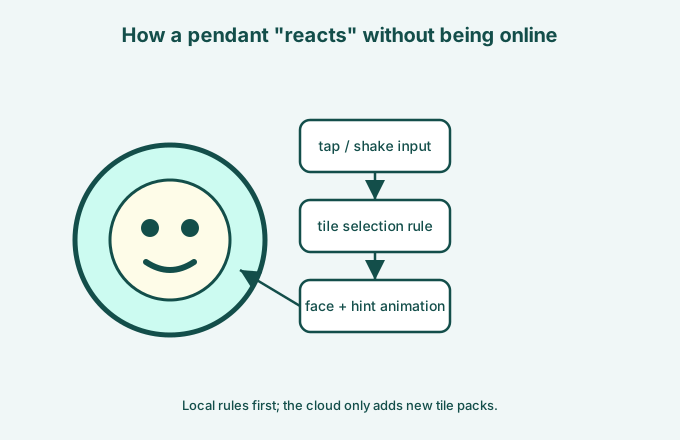
The most charming AI gadgets of the past year share one trait: their core loop never touches the network. A pendant that shows a knowing smile when you tap it, a keychain that draws a fortune card when shaken — these read as “smart” because the reaction is immediate and personal, not because a large model answered.
The reaction loop is three steps
Input (tap, shake, button), a selection rule (which tile or animation fits the moment), and playback (face plus a short motion). Every step runs on a small MCU. Latency budget: under a couple hundred milliseconds between input and first frame, or the magic dies.
Where the cloud earns its keep
The cloud is not for the loop; it is for the library. New tile packs, seasonal fortune decks, firmware updates — delivered over Wi-Fi when the pendant is parked on its charger. Connectivity that only syncs content can be slow, batched and unreliable without hurting the experience, which slashes the cost of the connectivity tier you need.
What this means for the bill of materials
An offline-first reaction loop lets you choose a low-power MCU, a small flash, and connectivity as an option rather than a requirement. The same product can ship as a Bluetooth-only version and a Wi-Fi version with the same shell and art.
The design trap: randomness mistaken for intelligence
A pure random pick feels dumb within a minute. The selection rule needs just enough state — time of day, recent interactions, streaks — to feel attentive. That state machine is the real “AI” of these devices, and writing it well is cheaper and more reliable than bolting on a voice assistant.